Curator's note
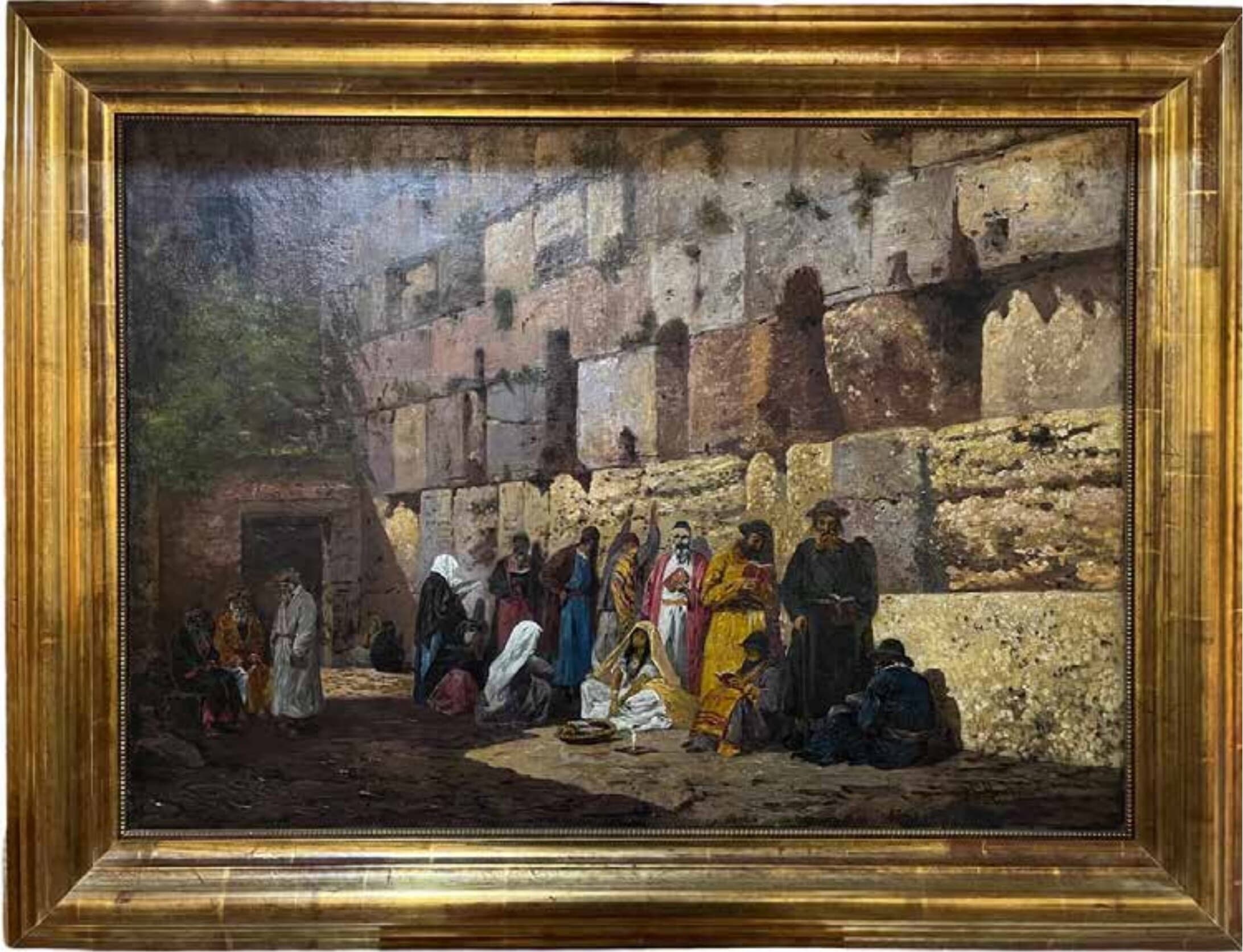
Painted in the early 1890s during Perlberg's Holy Land travels, Klagemauer Der Juden depicts worshippers gathered at the Western Wall in Jerusalem under a clear Levantine light. The composition gives the wall full architectural weight while individuating the figures at prayer; the palette is dry, ochre and limestone, with cooler shadows in the recessed courses of stone. The work belongs to a small body of late nineteenth-century European treatments of the site executed by artists who travelled to Jerusalem rather than working from photographs, and it is one of the larger surviving canvases of the subject from the period.
Subject
The Western Wall — Hebrew Ha-Kotel ha-Ma'aravi, German Klagemauer — is the surviving western retaining wall of the Temple Mount platform built under Herod the Great in the late first century BCE. By the late nineteenth century, when Perlberg was painting, the narrow alley before the wall was the principal site of Jewish prayer in Jerusalem and a recurring subject for European travelling artists, photographers, and writers of the period.
The artist
Friedrich Perlberg was born in Nuremberg in 1848 and trained at the Royal Academy of Fine Arts in Munich, where he later worked as an illustrator and painter. He travelled repeatedly to the eastern Mediterranean during the 1890s, producing watercolours and oils of Jerusalem, the Dead Sea, the Sinai Peninsula, and Egypt that were exhibited and reproduced widely in German and Austrian publications of the period. His work belongs to the late nineteenth-century Orientalist tradition that combined documentary precision with an atmospheric, often devotional sensitivity to sacred sites. Perlberg died in Munich in 1921.
All works in this catalog are offered subject to prior sale and to the conditions of inquiry set out elsewhere in this catalog. Pricing is provided in confidence on request.